
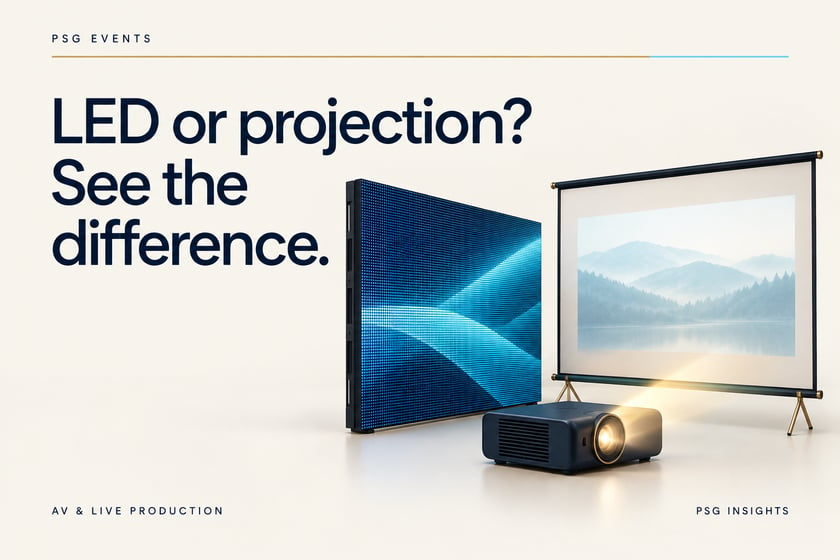
For decades, projectors were the default choice for conference general sessions. They were familiar, relatively affordable, and “good enough.” But expectations have changed—and so has the technology.
Today, conferences are increasingly switching from traditional projection to LED video walls. The reason is simple: LED screens outperform projectors in nearly every meaningful way, especially for modern, content-driven events.
If you’re investing heavily in speakers, programming, sponsorships, and audience experience, the screen behind your stage should elevate - not undermine - that investment. After all, your attendees paid a registration fee to see and hear the content shared from the stage.
Let’s break down why LED screens are quickly becoming the new standard.
1. Brighter Visuals—Even in Well-Lit Rooms
One of the biggest limitations of projectors is brightness.
Projectors rely on controlled lighting conditions. The moment you introduce ambient light like ballroom chandeliers, stage lighting, audience safety lighting, the image quality drops. Slides become dull, colors fade, and contrast suffers.
LED screens don’t have this problem.
LED video walls are self-illuminating and dramatically brighter than projection. That means:
-
Crisp visuals even in bright rooms
-
No need to dim the audience or compromise lighting design
-
Better visibility from every seat, including the back of the room
For conferences held in large ballrooms or multipurpose spaces (which is most of them), this alone is often the deciding factor.
3. Flexible Sizing and Modular Layouts
Projectors lock you into fixed screen sizes and aspect ratios. LED screens, on the other hand, are modular and highly customizable.
With LED, you can:
-
Build screens to fit your stage design exactly
-
Create ultra-wide, vertical, or custom-shaped displays
-
Design multi-screen layouts for branding, data, or storytelling
This flexibility allows production teams to design stages that feel intentional and modern - rather than constrained by equipment limitations.
For conferences focused on innovation, growth, or premium positioning, visual flexibility matters.
4. A Modern, Premium Look for Sponsors & Branding
Sponsors are paying for visibility, association, and brand alignment. LED screens deliver all three far more effectively than projection.
LED screens provide:
-
Rich, saturated brand colors
-
High contrast logos and motion graphics
-
A sleek, modern backdrop that feels “broadcast-ready”
In contrast, projected logos often appear washed out, uneven, or distorted—especially on large screens.
If sponsorship revenue is a key part of your event model, LED video walls don’t just look better - they protect sponsor value.
5. Better Camera Capture for Recordings and Live Streams
Hybrid and recorded content is no longer optional. Conferences are repurposing sessions for:
-
On-demand libraries
-
Social media clips
-
Marketing content
-
Virtual attendees
Projectors struggle on camera. The image often flickers, fades, or appears uneven due to refresh rates and lighting conflicts.
LED screens are built for the camera.
They deliver:
-
Clean visuals on broadcast and live stream
-
Better contrast and color balance
-
A polished, television-quality look
If you plan to record sessions - or monetize content after the event - LED screens dramatically improve production value.
The Bigger Picture: Protecting Your Investment
When conferences hesitate to upgrade to LED, it’s often framed as a cost decision.
But the real question isn’t:
“Is LED more expensive than projection?”
It’s:
“Does projection undermine the investment we’re already making?”
You’re investing in:
-
High-profile speakers
-
Carefully developed content
-
Sponsorship packages
-
Attendee experience and brand perception
LED video walls ensure that investment is delivered clearly, professionally, and memorably.
The shift from projectors to LED screens isn’t a trend - it’s a response to higher expectations.
Attendees expect clarity. Sponsors expect polish. Speakers expect freedom. Cameras expect broadcast-quality visuals.
LED screens meet all of those demands.
If your conference is designed to inform, inspire, and leave a lasting impression, the technology behind your stage should do the same.